Judged at the Security Line: How American Strangers Negotiate the Bag on Your Shoulder
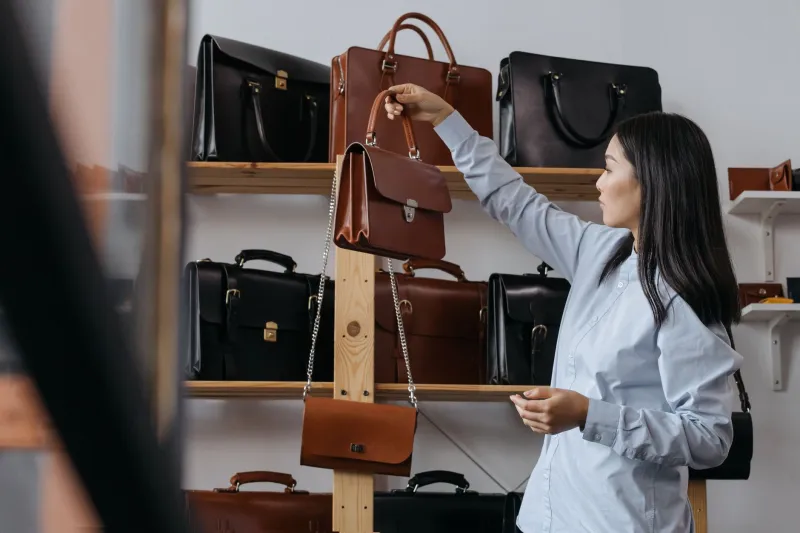
There is a moment, familiar to anyone who has flown out of a mid-sized American airport, when the contents of a handbag become public record. The laptop comes out. The quart-size bag emerges. And for roughly ninety seconds, strangers in line form provisional conclusions about the woman emptying a structured leather tote that clearly did not come from a big-box retailer.
No one says anything, of course. Americans are trained to be tactful about money and circumspect about status. But the assessment happens anyway — swiftly, silently, and with surprising consistency. The handbag occupies a peculiar position in American social life: it is one of the few possessions we carry into every room, visible to everyone, readable by anyone, and yet almost never discussed directly.
The Checkpoint Confessional
Etiquette consultants who work with executives describe the airport as the great equalizer and the great revealer. At the checkpoint, status symbols are reduced to bins, and the bag that commanded four figures at a boutique is nudged along a rubber belt beside a stack of plastic trays.
Yet frequent travelers often report the opposite of embarrassment. There is a particular confidence, they say, in a bag designed well enough to survive the indignity — one that opens smoothly, holds its shape, and signals competence rather than exhibition. In transient American spaces, where nobody knows your name or your neighborhood, the bag does the introducing. A quietly excellent one suggests someone who has nothing to prove. A loudly logosied one suggests someone who would like you to know something.
Neither reading is fair, and both happen constantly.
The Carpool Lane Paradox
Nowhere is the negotiation stranger than in the suburban pickup line, that most American of stages. Here, the luxury bag faces an unusual test: it must be impressive enough to matter and restrained enough not to alienate. A woman who arrives with a conspicuous status bag to collect a second-grader risks a different kind of reading than the same woman carrying it into a Manhattan restaurant.
The mothers who navigate this well tend to favor the unbranded, the structured, the expensive-looking-but-unplaceable. The bag must pass what one might call the minivan test — carried easily, set down on a sticky floor without flinching, and quiet enough that no one feels the need to remark on it.
The Open-Plan Office
In the American workplace, the calculus shifts again. The open-plan office, with its flattened hierarchy and its performative informality, has made overt displays of wealth awkward in ways the corner office never was. A junior colleague with a more expensive bag than her manager is a situation HR will never address but everyone will privately note.
The result is a new professional vocabulary of restraint: bags in muted leathers, heritage shapes, and house codes legible only to those who know. The message being sent is subtle but deliberate — I could have bought the loud one. In American professional culture, the most persuasive flex is often the withheld one.
The First Date and the Question of Intent
Then there is the first date, where the bag's audience is a single person making a decision in real time. Etiquette experts note that daters read handbags not for price but for implication: a pristine, rarely-used bag suggests someone dressing up for the occasion; a broken-in, well-loved one suggests a life already in motion. Neither is right. But the stranger across the table will draw a conclusion anyway, usually within the first drink.
What We Owe the Stranger
None of these readings are accurate. A bag is not a biography. But it is worth acknowledging, honestly, that in a country of strangers — commuters, travelers, parents in pickup lines — the handbag performs an enormous share of our first impressions.
The most considered response is not to abandon the bag that brings you pleasure, nor to weaponize it, but to carry it with awareness. Choose pieces whose message you can stand behind in every room they will enter. Because in American life, the interview begins at the door — and the bag speaks first.