Six Pounds of Who We Are: Inside the American Handbag's Beautiful Burden

Photo: Yare zaman2000, CC BY-SA 4.0, via Wikimedia Commons
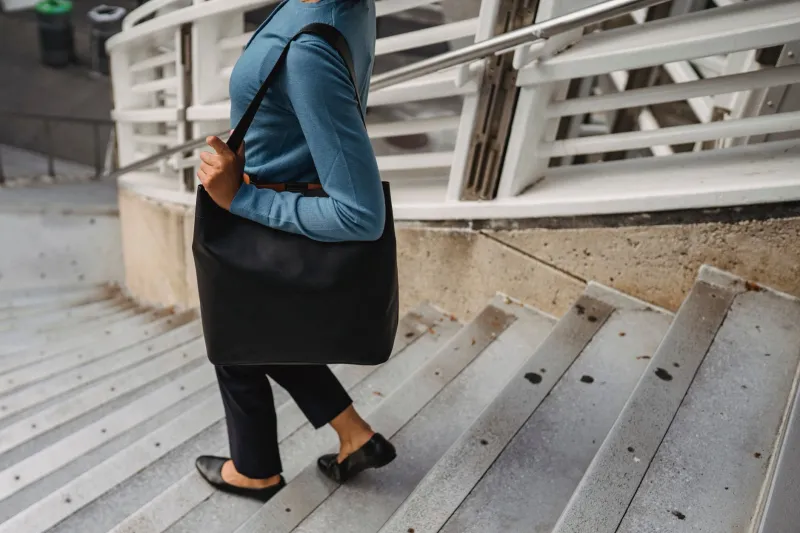
Somewhere between the front door and the office, the modern American handbag became a load-bearing structure. Industry estimates put the average carry weight north of six pounds — heavier, notably, than a Chihuahua, a bottle of wine, or the average newborn's head. And yet we rarely question it. We simply swing it over a shoulder, adjust the strap, and walk into the day carrying what amounts to a small dumbbell dressed in calfskin.
At Werf Bag, we spend a great deal of time thinking about what a bag says before it's opened. But this week, we got curious about what it says after — about the contents, the cargo, the quiet archaeology of daily American life.
The Contents of a Nation
Ask ten women what's in their bag and you'll hear ten small biographies. There is the attorney in Chicago whose tote holds a 13-inch laptop, a paperback she hasn't opened in three weeks, and a chess set she swears she'll use on lunch breaks. There is the nurse in Austin who carries two phones — one for work, one for a life that doesn't get interrupted at 3 a.m. There is the new mother in Portland whose bag contains, by her own cheerful admission, "half a nursery and one lonely lipstick."
The through-line is not frivolity. It is preparedness. The American bag is a portable insurance policy against every contingency the day might present: the dead phone, the sudden rain, the meeting that materializes without warning, the hunger strike between lunch and dinner. We carry because the country we've built asks us to be ready for everything at once.
And so the heft accumulates. Laptop, charger, water bottle, sunglasses, prescription readers, a folder of documents, snacks for children we may or may not be escorting. Six pounds becomes eight. Eight becomes a shoulder that aches on the drive home.
What the Scale Reveals
There is something faintly comic about it — we will spend four figures on a bag and then fill it with gas-station receipts. But there is something earnest in it too. The weight we carry is a rough census of obligation. Look into any commuter's bag on the L train or the 405 and you are looking at a to-do list with a zipper.
The humor writes itself, but the meaning runs deeper. For decades, luxury design treated the handbag as sculpture: beautiful, structured, occasionally architectural. It was not asked to apologize for weighing as much as the ambitions it accompanied. A structured tote had presence. Presence had heft. That was the deal.
The Featherweight Rebellion
Which is what makes the current design moment so interesting. Across the luxury landscape, a quiet engineering race has begun — a movement toward featherweight totes that promise the same polish at a fraction of the mass. New tanning processes yield leathers that drape like silk but wear like armor. Hardware has slimmed down. Linings have been rethought. Some houses now list bag weights in their product specifications the way performance brands list shoe weights, and shoppers — shoulders throbbing, laptops multiplying — are paying attention.
This is not minimalism for its own sake. It is a response to how American women actually live, which is to say: everywhere, all at once, with a phone that never stops and a schedule that doesn't either. When a designer can shave a pound off a work tote without surrendering an ounce of elegance, that is not a gimmick. That is listening.
The Choice, Reframed
Here at Werf Bag, we believe a handbag should be carried with intention — and intention, it turns out, extends to the scale. The question is no longer only does it suit me? but what am I asking my body to carry, and why? Some will answer with a pared-down micro bag and a ruthless edit of the everyday. Others will keep the beloved heavy tote and simply stop apologizing for it. Both are defensible. Both are, in their way, declarations.
Because the weight we choose has never really been about the objects. It is about the lives we're preparing for — and increasingly, thanks to designers who finally did the math, we get to decide how much of that preparation has to hurt.
Carry what you need. Carry what you love. But carry it deliberately.