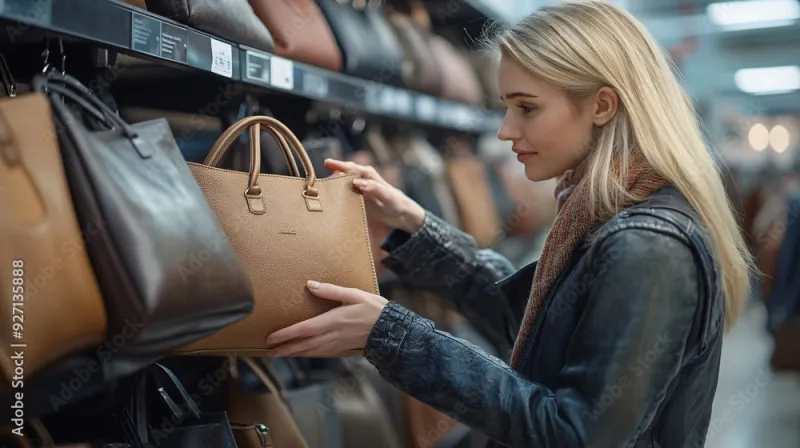
Proportions With Purpose: A Considered Guide to Finding Your Ideal Handbag Size
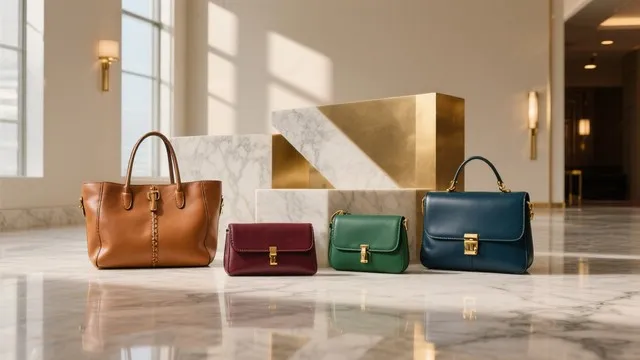
Photo: luxury handbags different sizes arranged on white marble surface editorial fashion, via images.stockcake.com
The handbag you reach for each morning is, in a quiet but meaningful way, a declaration. It communicates how you move through the world—what you prioritize, how much you like to prepare, and whether you are drawn toward restraint or abundance. And yet, for all that expressive weight, most people choose their bag size based on what they have seen on a runway or on the arm of someone they admire, rather than on any deliberate consideration of their own lives.
The result, predictably, is a collection of bags that do not quite work: the beautiful mini that requires you to leave half of your essentials at home, the capacious tote that swallows everything and returns nothing easily, the medium shoulder bag that seemed perfect until you realized the strap hits exactly the wrong place. These are not failures of taste. They are failures of proportion—and proportion is something that can be learned.
Understanding the Spectrum
The contemporary handbag market organizes itself across a remarkably wide size range. At one extreme, the micro and mini categories—bags measuring roughly four to seven inches across—function more as accessories than as utility tools. They carry a phone, a card, a key, and perhaps a lip product. Nothing more.
At the other end, oversized totes and structured large bags can accommodate laptops, gym clothes, a change of shoes, and the accumulated detritus of a full professional day. They are, in essence, soft luggage.
Between these poles lie the medium and small-medium silhouettes that represent the majority of the market: crossbodies, structured satchels, half-moon bags, and the enduring shoulder bag. These sizes do the most work for the most people—but even within this range, the difference of two inches in either direction can determine whether a bag feels liberating or limiting.
The Lifestyle Audit: Starting With Honest Questions
Before considering aesthetics, consider function. A useful exercise is to empty your current bag onto a flat surface and examine its contents without editing. What you actually carry—not what you intend to carry—defines your minimum size requirement.
For most working women in American cities, the non-negotiables include a smartphone (which has grown considerably in the past decade), a wallet or card holder, keys, some form of lip or skin care, and frequently either a small notebook or earbuds. For those who commute by public transit, a transit card and perhaps a paperback or e-reader enter the equation. For parents, the calculus shifts dramatically—a bag that cannot accommodate a snack, a small toy, and a backup mask or wipe will fail in the field, regardless of its beauty.
Be honest about this inventory. The bag you carry on a Tuesday in October is more instructive than the bag you imagine carrying on a Saturday in May.
Body Proportion and Visual Harmony
Once utility is addressed, proportion becomes a matter of visual balance—and here, body type enters the conversation not as a restrictive rule but as a useful guide.
The underlying principle is contrast and scale. A bag that is significantly larger or smaller than the wearer's torso creates visual tension that can feel either intentional and dynamic, or simply awkward. Generally speaking:
Petite frames benefit from bags in the small-to-medium range, as oversized silhouettes can visually overwhelm a compact frame. That said, a deliberately oversized bag worn with conviction reads as a style choice rather than a proportion error—the distinction lies in intentionality.
Taller or broader frames can carry larger bags with ease, and often find that mini bags disappear against their silhouette rather than punctuating it. A bag that reads as chic and understated on a petite woman may read as merely small on a taller one.
Strap length is an underappreciated variable. Where a bag sits on the body—at the hip, at the waist, under the arm—changes its visual relationship to your frame entirely. Many luxury bags offer adjustable straps for precisely this reason. Before dismissing a size as wrong, experiment with where it lands.
The Psychology of Capacity
There is a psychological dimension to bag size that rarely appears in style guides but deserves acknowledgment. The amount of space you carry influences how you feel about your preparedness for the day.
Some people experience genuine anxiety when carrying a bag that cannot hold everything they might need. For these individuals, a larger bag is not an indulgence—it is a practical expression of their relationship with readiness. Forcing a smaller bag on them in the name of trend compliance produces discomfort that no aesthetic reward can offset.
Others find that a large bag becomes a crutch—a permission structure for accumulating weight and clutter that ultimately makes them feel burdened rather than prepared. For these individuals, the discipline of a smaller bag is clarifying. It forces prioritization and produces a lightness that feels like freedom.
Knowing which category you occupy is not a small thing. It is the foundation of a bag choice that will serve you rather than frustrate you.
The Case for Owning Across Multiple Sizes
The most practical resolution, for those who can accommodate it, is a deliberate rotation across two or three sizes calibrated to different contexts. A medium structured bag handles professional days with competence and composure. A crossbody in the small-medium range serves evenings, weekends, and travel with equal authority. A larger tote absorbs the demands of gym days, travel days, and any occasion requiring more than the essentials.
This is not an argument for accumulation without purpose—it is an argument for intentional curation. Each bag in a considered rotation serves a defined role, which means each one performs better and feels more satisfying than a single bag pressed into service across all occasions.
Making the Final Decision
When evaluating a specific bag, apply three questions in sequence. First: does it hold what I actually carry? Second: does it sit well on my body in terms of visual proportion and physical comfort? Third: does the scale feel psychologically right for how I want to move through the day?
If the answer to all three is yes, the size is correct—regardless of what is trending this season. A bag that fits your life with precision is always the right choice. That is what it means to carry with intention.