Carried With Authority: What Research and High-Achieving Women Reveal About the Psychology of the Luxury Handbag
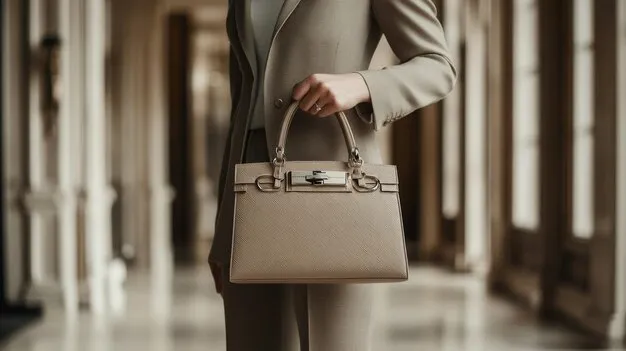
Photo: confident professional woman luxury handbag business meeting elegant, via img.freepik.com
The moment is familiar to many women who operate at the intersection of ambition and aesthetic: you walk into a room carrying a bag you love—truly love—and something shifts. The posture adjusts almost imperceptibly. The voice carries a fraction more certainty. The handshake is offered first. It is easy to dismiss this as superstition, the kind of self-flattery that comes from spending more than you planned. But a growing body of research in fashion psychology and behavioral science suggests that what is happening in those moments is neither trivial nor imaginary.
The relationship between a luxury handbag and the woman who carries it is, it turns out, a subject worthy of serious inquiry.
What the Research Actually Says
The psychological concept most relevant to this conversation is enclothed cognition—a term introduced by researchers Hajo Adam and Adam Galinsky in a 2012 study published in the Journal of Experimental Social Psychology. Their work demonstrated that the symbolic meaning of clothing, when internalized by the wearer, measurably influences cognitive performance and behavior. Participants who wore a lab coat they were told belonged to a doctor performed better on attention tasks than those who wore the same coat but were told it was a painter's smock. The garment was identical. The meaning was not.
While that study focused on clothing, subsequent research has extended the principle to accessories, including handbags. A 2018 study conducted by researchers at the University of Michigan examined how luxury goods influenced the self-concept of women in professional settings. Participants who carried or were primed to think about a luxury accessory prior to a simulated negotiation reported higher confidence levels and, critically, achieved measurably better outcomes in those negotiations than the control group. The bag, in this context, was not merely decorative. It was functional—a tool that activated a particular internal state.
The Signaling Dimension
Beyond what a bag does for its owner internally, there is the equally significant question of what it communicates externally. Social psychologists have long studied the role of material cues in forming first impressions, and the findings are consistently sobering in their precision. Within seconds of an initial encounter, observers make judgments about competence, social status, and even personality traits based on visible accessories.
A well-chosen luxury handbag, research suggests, functions as what sociologists call a status cue—an object that communicates not merely wealth, but a particular kind of cultural literacy. The distinction matters. A conspicuously logo-heavy bag reads differently than a quietly exceptional one. The former signals acquisition; the latter signals taste. In high-stakes professional environments—boardrooms, client dinners, industry conferences in cities like New York, San Francisco, or Chicago—that distinction is legible to those who know how to read it.
This is not to suggest that the purpose of a handbag is to impress others. It is to acknowledge that the social dimension of the object is real, documented, and worth understanding.
Voices From the Field
The data becomes more vivid when grounded in lived experience. Consider the account of a corporate attorney based in Washington, D.C., who describes the deliberate role her Bottega Veneta Jodie plays in her courtroom preparation ritual. "I don't think of it as a bag when I'm getting ready for a difficult day," she has said. "I think of it as an anchor. Holding it, I feel like a version of myself that has already won."
Or the creative director at a mid-size agency in Los Angeles who keeps a vintage Gucci Jackie—purchased at a consignment shop in her early thirties—specifically for new client pitches. "There is something about carrying something with history that makes me feel less like I need to prove myself," she explains. "The bag has already been somewhere. That matters to me."
These are not isolated anecdotes. They reflect a consistent pattern reported by high-achieving women across industries: the handbag functions as a psychological anchor, a material manifestation of an internal standard they hold themselves to.
The Concept of the Talisman
In anthropological terms, what these women are describing is the talisman—an object imbued with personal meaning that serves a protective or empowering function. The luxury handbag, in this reading, is not so different from the worn family ring carried into a difficult conversation, or the particular pair of shoes worn to every important interview. The material quality of the object matters, but only insofar as it earns and sustains the trust of its owner.
This is why the relationship between a woman and a truly right bag tends to be described in terms that sound almost relational. Women speak of bags they "grew into," of pieces that "understood" their aesthetic before they fully did, of retiring a beloved bag with something approaching grief. These are not the reactions of consumers to products. They are the responses of individuals to objects that have participated meaningfully in their lives.
Choosing With Intention, Carrying With Authority
Understanding the psychology of the luxury handbag does not mean approaching every purchase as a therapeutic exercise. It does, however, suggest that the question of which bag to carry into a defining moment deserves more than a cursory glance at what happens to be trending.
The most powerful acquisitions are those made with an awareness of what the piece represents to you—not to the market, not to an algorithm, not to the colleague who will notice the logo from across the conference table. The bag that makes you stand differently, speak more clearly, and enter a room as though you have already earned your place in it is not a luxury in the frivolous sense. It is, by any rigorous measure, an investment in the quality of your presence.
At Werf Bag, that is precisely the kind of investment we believe in.