A Bag for Every Chapter: Selecting Designer Pieces That Remain Relevant Through Life's Defining Transitions

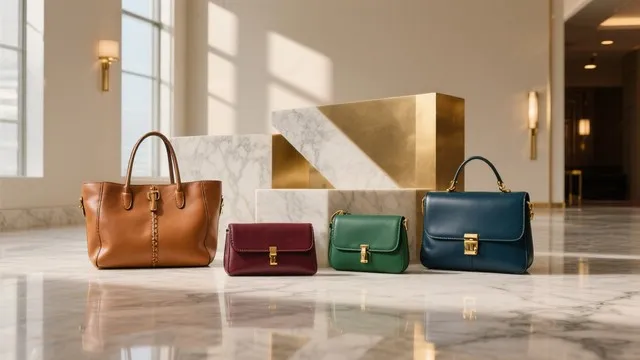
Photo: Patricia Arévalo, CC BY-SA 4.0, via Wikimedia Commons
There is a particular kind of wisdom that comes with owning a bag for a decade. You remember where you carried it first—perhaps a first-round interview at a firm you had long admired, or a Sunday at a downtown farmers market when your life still felt entirely your own. Then, slowly, the bag accumulates context. It sits beside a hospital bassinet. It accompanies you to a board presentation. It travels to a city you moved to because you finally decided to begin again.
The most enduring luxury handbags are not simply accessories. They are quiet witnesses to the life you are building. Selecting one with that kind of longevity in mind requires a different framework than choosing something purely for this season's aesthetic.
The Myth of the Perfect Bag for Right Now
American consumer culture has a tendency to encourage immediacy—the bag that is right for this job, this relationship, this version of yourself. But the style-conscious woman who thinks in decades rather than seasons understands that such thinking leads to a closet full of beautiful objects that no longer feel like hers.
The alternative is what we at Werf Bag call intentional acquisition: choosing pieces not only for who you are today, but for who you are in the process of becoming. This is not a mystical exercise. It is, in fact, a highly practical one.
Structure as the Foundation of Longevity
The first quality to examine in any bag you hope to carry across life's chapters is structural integrity—not merely in the physical sense, though that matters enormously, but in terms of silhouette. Bags with clean, architectural lines tend to resist the gravitational pull of trends. A well-proportioned trapeze shape, a refined half-moon, a structured tote with discreet hardware—these forms have demonstrated staying power across decades of fashion cycles precisely because they do not overcommit to any single era.
Consider how the Celine Box bag reads as elegantly today as it did when Phoebe Philo first introduced it to a generation of women who were redefining what professional dressing could look like. Or how a classic Gucci Bamboo handle bag—first produced in postwar Florence when leather was scarce—continues to feel both of-the-moment and timeless at once. These are not accidents of taste. They are the result of design decisions rooted in proportion, restraint, and material honesty.
Functionality That Grows With Your Priorities
In your late twenties, you may need a bag that transitions from desk to dinner with minimal effort. By your mid-thirties, you might require something that accommodates a tablet, a child's snack, and a tube of concealer without sacrificing the visual dignity of a considered outfit. A decade later still, you may find yourself drawn back to something smaller and more refined, now that your life has contracted to its most essential and deliberate form.
The bags that serve all of these seasons tend to share a few practical characteristics. Interior organization that is thoughtful without being rigid allows the bag to adapt to shifting contents. Convertible straps—those that allow a piece to be worn crossbody, over the shoulder, or carried by hand—extend a bag's relevance across contexts that your younger self may not have anticipated. Neutral colorways in rich, saturated tones (a deep cognac, a warm black, a dusty taupe) age gracefully in a way that trend-driven hues rarely do.
The Investment Conversation, Honestly
It would be disingenuous to discuss longevity without addressing the financial dimension. A luxury handbag purchased with intention is, in many respects, a more economical decision than rotating through lower-cost alternatives every few years. The cost-per-wear calculus is straightforward: a $3,500 bag carried consistently for fifteen years costs a fraction of what three $1,200 bags purchased over the same period would amount to—and the former is far more likely to hold or appreciate in resale value.
Certain houses have demonstrated particular resilience in this regard. Hermès, Louis Vuitton's monogram canvas line, and Chanel's classic flap have each maintained or exceeded their original retail value on the secondary market, with some styles achieving returns that rival conventional investment vehicles. But beyond financial appreciation, there is a different kind of value in owning something that continues to feel worthy of you as your taste matures and your standards deepen.
Choosing the Bag Before You Need It
One of the most useful exercises for the long-view buyer is to envision not just your current life, but the life you are working toward. If you are building toward a leadership role, consider whether the bag you are drawn to today will still command the room in five years. If you anticipate significant change—a relocation, a career pivot, a shift in how you spend your days—ask whether the piece in question is flexible enough to follow you there.
This is not about being prescriptive or rigid. Taste evolves, and a bag that no longer suits you can always find a new home. But the most satisfying acquisitions are those that feel like they were waiting for you—pieces you grow into rather than out of.
The Heirloom Possibility
Finally, there is a dimension to the long-view purchase that extends beyond your own lifetime. A well-maintained designer bag, stored with care and repaired when necessary, can become an object of genuine familial significance. The Chanel 2.55 that your mother carried to her first gallery opening. The structured Bottega Veneta intrecciato tote that accompanied your aunt through a decade of international travel. These are not sentimental exaggerations—they are the natural result of choosing quality over convenience, again and again, until the bag becomes inseparable from the story of a life well-lived.
At Werf Bag, we believe that the most powerful thing a handbag can be is not trendy, not status-signaling, not even beautiful—though it may be all of these things. The most powerful thing it can be is yours, truly and durably, across every chapter that follows.