Beneath the Surface: A Visit to the Ateliers Where American Luxury Bags Take Shape
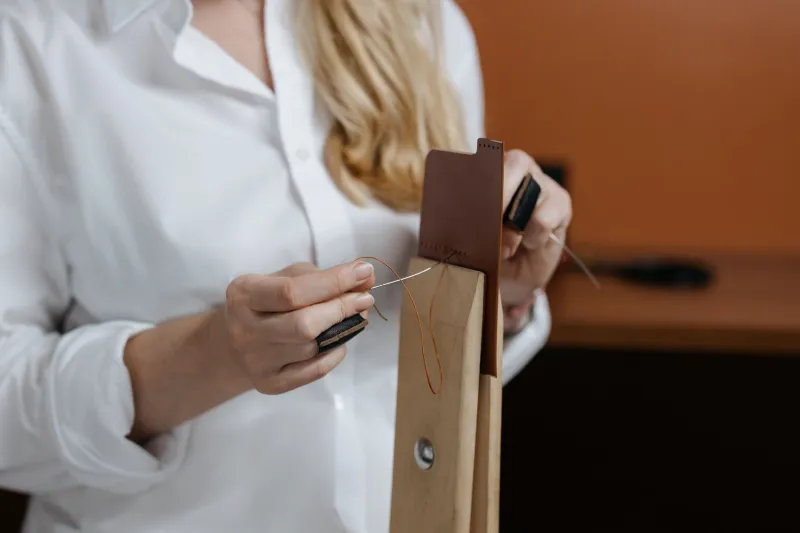
There is a moment in every serious atelier that stops first-time visitors cold: the sound. Not the hum of machinery one might expect from a factory floor, but the steady, rhythmic pull of waxed linen thread drawn through vegetable-tanned leather, stitch by deliberate stitch. It is the sound of luxury being made the slow way.
For the American consumer, the word "luxury" is most often encountered at retail — under glass, on a dust jacket, beside a price tag. Rarely do we encounter the other end of the transaction: the workshop bench, the tempered steel awl, the craftsman who has spent three decades learning to paint a bag's edge so smoothly it looks poured rather than applied. Understanding what happens in these rooms changes how one shops. It reframes the question from is this bag worth the money? to is this bag worth the hours?
The Economics of Patience
A single handbag from a heritage house may require anywhere from fifteen to forty hours of skilled labor. Saddle stitching — the two-needle technique borrowed from harness makers and still considered the gold standard for structural seams — proceeds at roughly one stitch per second in experienced hands. A machine can accomplish the same seam in a fraction of the time, but the distinction matters: a saddle-stitched seam, locked at every stitch, will not unravel even if the thread is severed. A machine lockstitch, by contrast, can begin to fail from a single broken thread.
This is not nostalgia for nostalgia's sake. It is engineering, and it is the honest justification behind a four-figure price. When a craftsman explains that a bag's handle must be conditioned, skived, folded, and stitched before it can even be attached — and that the attachment itself may involve reinforcing layers of leather at the stress point — the arithmetic of luxury begins to make sense. You are not paying for a logo. You are paying for the refusal to take shortcuts.
Tanning: The Foundation Nobody Sees
Long before a bag takes shape, its character is determined at the tannery. Vegetable tanning, which uses tree bark tannins over a period of weeks, produces leather that develops a patina — darkening, softening, recording the life of its owner. Chrome tanning, faster and more common in mass production, yields a uniform material that resists change.
Neither method is inherently superior, but they produce fundamentally different objects. The collector who treasures the honeyed evolution of a natural-finish bag is choosing vegetable tanning's philosophy: leather as a living record. The buyer who wants a bag to look identical on day one thousand is served equally well by modern methods. Knowing which you prefer — and why — is among the most useful pieces of knowledge a handbag purchaser can possess.
Reading the Evidence: Handwork Versus Machine Production
For those evaluating a purchase, whether at a boutique or on the resale market, several telltale signs distinguish handwork from pure machine production:
- Stitch character. Hand stitches carry a slight, intentional slant and vary almost imperceptibly in spacing. Machine stitches sit perfectly vertical and metronomically even. On high-end pieces, the slight irregularity is not a flaw — it is a signature.
- Edge finishing. Hand-painted edges build up in thin, cured layers, burnished between coats. They feel dense and rounded. Machine edges often appear flat, with paint that can crack at corners over time.
- Corner geometry. Sharp, symmetrical corners on structured bags demand skilled hand-turning. Machines struggle where leather must be coaxed, not forced.
- Thread ends. Craftsmen secure thread tails invisibly, often backstitching through the seam itself. Visible knots or glued ends suggest assembly-line expedience.
- Interior honesty. Turn a bag inside out. The quality of the interior — clean seams, finished edges, considered lining — reveals what the maker thought no one would check.
Why This Matters to the American Buyer
The US market has grown increasingly sophisticated about provenance. Resale platforms document condition down to corner wear and glazing, and buyers have learned that construction — not branding — determines how a bag ages. A well-made piece from an atelier with rigorous standards will outlast trends, seasons, and frequently its original owner's taste, which is precisely why certain bags hold value while others depreciate into obscurity.
There is also a quieter argument, one closer to the ethos we hold at Werf Bag: intentionality. To carry a bag made by human hands, using methods refined over generations, is to participate in a chain of skill that stretches from your shoulder back to a workbench you will never see. In an era of disposable goods, that connection is itself a form of luxury — perhaps the most durable one available.
The next time you consider a significant purchase, look past the monogram and read the stitching. The bag will tell you the truth about how it was made. Your job is simply to know the language.